Introduction
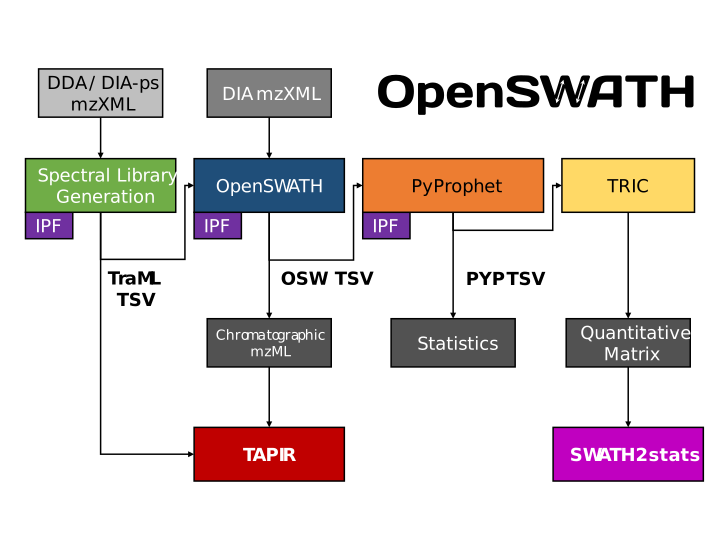
The OpenSWATH Workflow enables targeted data analysis of data-independent acquisition (DIA) or SWATH-MS proteomic data. The main workflow consists of OpenSWATH, PyProphet, TRIC, IPF and TAPIR. This website provides documentation on installation and application of the tools.
News
Note
2025-10-12: Updated Docker image (openswath/openswath:0.3.0), and added an Apptainer image build for the latest development version of the OpenSWATH workflow, including OpenMS 3.4.1, PyProphet 3.0.2, easyPQP 0.1.53, sage 0.14.7, arycal 0.1.10, and DIAlignR 2.0.0
Note
2025-05-09: With OpenMS 3.4.0, OpenSWATH supports automated spectrum addition at RT feature peak apex, peak picking extracted ion mobilograms, and ion mobility scoring for identifying transitions for IPF.
Note
2020-02-24: With OpenMS 2.4.0, OpenSWATH supports ion mobility extraction and scoring (diaPASEF data), supports PRM data, supports metabolite assay library generation (via SIRIUS), extraction and scoring.
Note
2018-11-07: The Docker image now includes OpenMS 2.4.0 and PyProphet 2.0.1.
Note
2018-11-07: With the release of OpenMS 2.4.0 and PyProphet 2.0.1, the new OpenSWATH workflow is available in the release branches.
Note
2018-03-22: We provide an experimental Docker image for the latest development version of the OpenSWATH workflow.
Note
2017-12-28: The tools of the OpenSWATH Workflow now provide experimental support for new SQLite-based file formats.
The OpenSWATH Workflow
Installation
Getting Started
Spectral library generation
Calibration libraries
Targeted data extraction
Statistical validation
Multi-run alignment
PTMs / Peptidoforms
Chromatogram visualization
Mobi-DIK (diaPASEF)
Differential expression analysis
Acknowledgments
The tools and workflows are being developed at the Aebersold Group at IMSB, ETH Zurich, University of Toronto and Columbia University with contributions from others. The core components are implemented as part of the OpenMS framework, the PyProphet, and msproteomicstools distributions.